
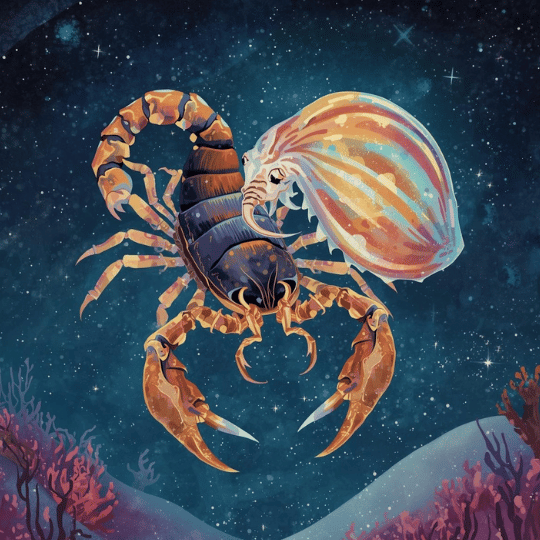
There is something I find fascinating about the places where systems of healing overlap. Where an ancient astrological symbol and a homeopathic remedy seem to be describing the exact same thing, just in different languages. If you are familiar with my work, I am a naturopathic practitioner as well as a Medical Astrologer.
This post is a semi-personal one. Six months postpartum, I found myself reaching for Sepia 200C. I recognised myself in it. The detachment. Going through the motions of mothering while feeling oddly removed from it all. The exhaustion that sleep didn’t touch. The irritability toward the people I love most, followed by guilt. Sepia began to restore something in me. And as I sat with the remedy, I kept thinking: this is Scorpio. This is exactly what a Scorpionic woman in depletion looks like.
My Moon is in Scorpio. This is what I want to explore.
The Scorpio Moon Woman
Scorpio is a fixed water sign, ruled by Pluto (modern) and by Mars (traditional). It is the sign of the depths. Where other water signs feel and flow, Scorpio feels and holds. Emotions don’t move through easily here. They settle deep in the body and the psyche, sometimes for years.
The Moon is in its fall in Scorpio. This means the soft, instinctive, emotionally expressive energy of the Moon sits uncomfortably in Scorpio’s intensity. A Scorpio Moon woman feels things deeply but struggles to express them. Emotions get suppressed and stored. Over time, this creates a particular kind of toxicity, both emotional and physical.
The Scorpio woman is intensely magnetic. There is something dark and knowing about her. She can see through people, through pretence, through the surface of things. She is drawn to the taboo: the occult, death, transformation, sexuality. She makes an excellent sleuth of the human soul.
But she can also swing from intensely passionate to completely cold, from deeply engaged to utterly withdrawn. She carries resentment for a long time. Scorpio doesn’t forgive easily and doesn’t forget. Not from cruelty, but because she feels everything so deeply.
When she is depleted by pregnancy, hormonal upheaval, or simply years of giving too much, she goes dark. She goes cold. She retreats.
She looks, in other words, very much like a Sepia patient.
The Sepia Picture
Sepia is prepared from the ink of the cuttlefish, a deep-sea creature that retreats into darkness when threatened. The image is fitting.
The defining feature of the Sepia state is emotional disconnection, particularly from loved ones. She may love her family but can no longer feel it. She is present but not really there. This creates a lot of guilt and confusion in a woman who knows herself to be caring and capable.
She is strong-willed and independent, often someone who has given everything of herself until she has nothing left. The exhaustion of Sepia is not ordinary tiredness. It is depletion on every level: physical, hormonal, and emotional.
She doesn’t want consolation or sympathy. She wants to be left alone. She may weep but the tears feel unwanted, coming from somewhere she can’t quite locate. There is often a sharp, sarcastic edge. Underneath it is deep sadness and a sense of being overwhelmed.
Physically, Sepia is a deeply hormonal remedy. It speaks to the pelvic floor, the reproductive organs, the liver, and the skin. Hormonal fluctuations, irregular periods, postpartum depletion, menopausal symptoms, low libido, hair loss, nausea, and that characteristic sallow skin.
Where Scorpio and Sepia Meet
The parallels are striking, and I don’t think they are coincidental.
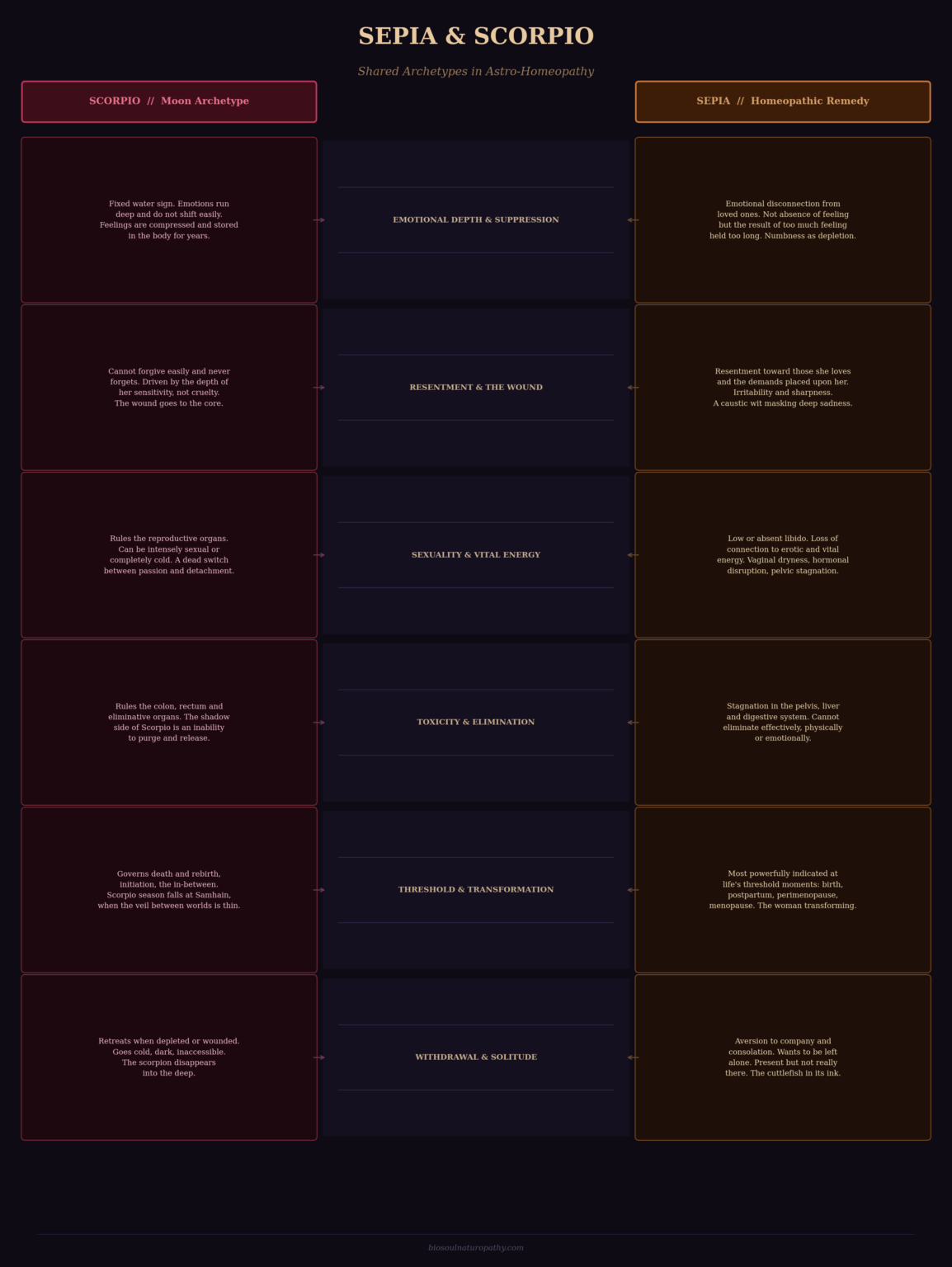
Both speak to emotional depth that has turned inward and become stagnant. In Scorpio, the fixed water nature means emotions don’t flow freely. They pool. In Sepia, the emotional life has been suppressed until it can no longer be felt at all. The numbness of Sepia is not the absence of feeling. It is the result of too much feeling, held too long.
Both carry resentment. The Sepia woman resents the demands placed upon her. The Scorpio woman carries the wounds of those who have wronged her, quietly and for a long time. In both, this is rooted in depth of feeling, not shallowness.
Both have a complicated relationship with sexuality and vitality. Scorpio rules the reproductive organs and the transformative energies of sex. Sepia addresses low libido, hormonal disruption, and a woman’s disconnection from her own vital energy.
Both are connected to toxicity and elimination. Scorpio rules the colon and the eliminative organs. Sepia is a remedy for physical and emotional stagnation: in the pelvis, the liver, the digestive system.
And both are deeply associated with womanhood at threshold moments. Scorpio governs death and rebirth, transformation, initiation. Sepia is most powerfully indicated at exactly these passages: the postpartum period, perimenopause, menopause. Moments when a woman is being asked to transform.
Both speak to the woman who has become cut off from her own depths. The Scorpio woman who has suppressed her emotional life. The Sepia woman who can no longer feel her own heart.
A Note on Prescribing
I want to be clear that I am not suggesting every Scorpio woman needs Sepia, or that every Sepia patient is a Scorpio. Homeopathy is always individualised. The totality of symptoms is what guides remedy selection. A depleted Scorpio Moon may equally present as Lachesis, Natrum Mur, or something else entirely depending on the full picture.
What I am saying is that astrology and homeopathy often describe the same human experience in different ways, and understanding one can deepen the other. The Scorpio archetype helped me recognise myself in the Sepia picture. And Sepia brought me back to myself when I was very far away.
That is the beauty of astro-homeopathy. Not a rigid system, but a richer way of seeing a person and finding the remedy that meets them where they are.
My name is Ash, and I am a naturopath based in the Perth Hills, Kalamunda. I am also a medical astrologer and offer birth chart readings with a focus on health and constitution. If any of this resonates with you, or you’d like to explore your own chart, I’d love to hear from you.