
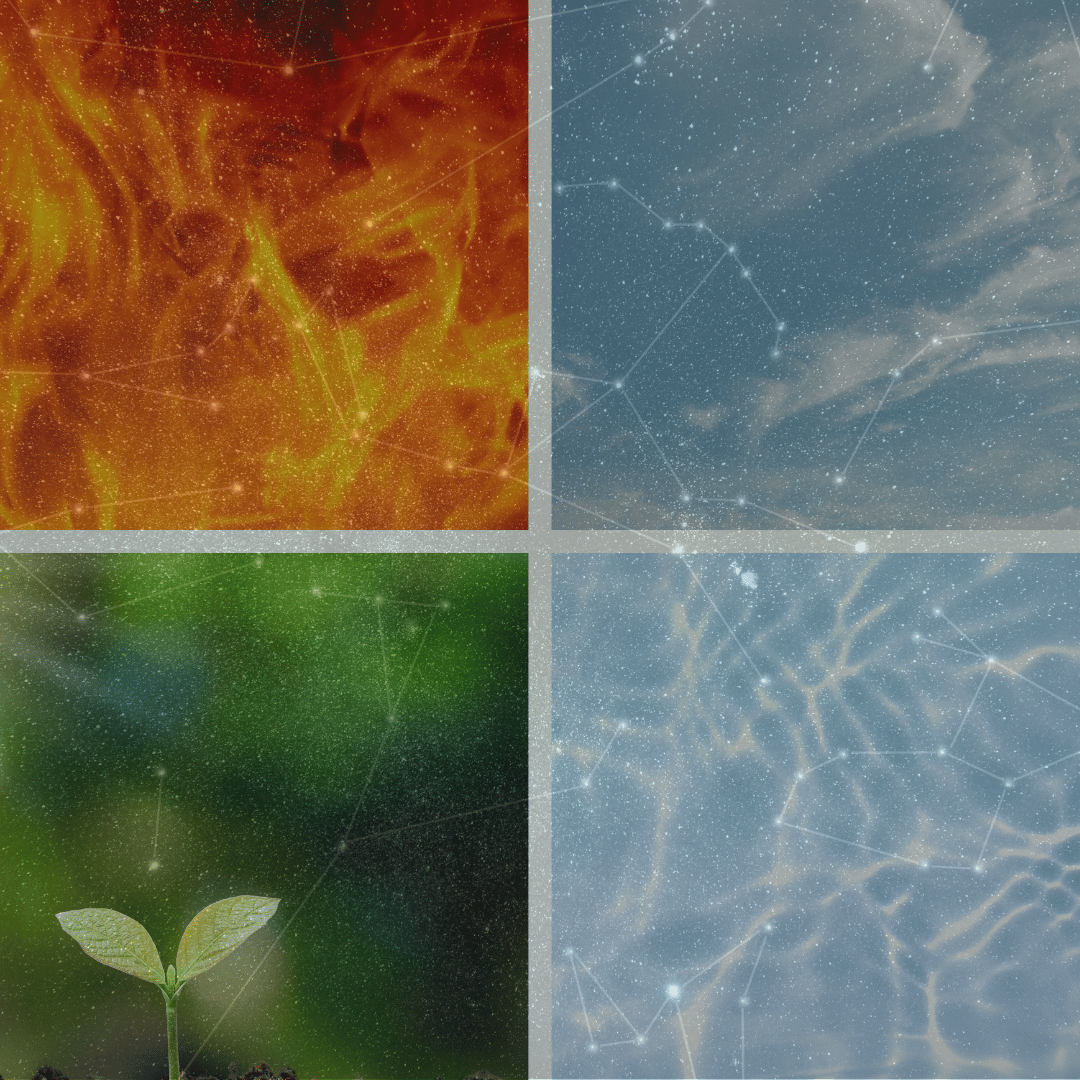
When I sit down with a client’s chart, one of the first things I look at is which element is dominant. It’s a great way to get a broad read on someone’s energy, how their body tends to respond to stress and illness, and their overall constitution, before I get into the nitty gritty of individual placements!
The four elements, fire, earth, air, and water, represent the basic states of matter and how energy moves through a system. The four-element theory has its roots in ancient Greek philosophy, where thinkers such as Empedocles proposed that all life was composed of these four fundamental elements. This concept was later expanded by Hippocrates and Galen, who linked the elements to the four humours of the body, creating the foundation of Western medicine for centuries. These elemental principles became woven into medical astrology, with each element representing distinct physiological functions, constitutional tendencies, and patterns of health and disease. Today, us medical astrologers use the elements not only to understand personality and temperament but also to assess vitality, energetic balance, and potential constitutional strengths and weaknesses within the natal chart, offering valuable insight into an individual’s holistic health. Every chart has all four elements within it to some degree, but most people lean heavily toward one or two.
Here’s how each one tends to show up in the body.
Fire types usually have a dynamic, energetic build and a naturally warm constitution. This often shows up physically as vibrant vitality: bright eyes, a warm skin tone, strong muscular definition. Fire dominance supports excellent energy and natural drive, but it’s worth staying mindful of this element’s tendency toward overexertion and inflammation.
From an astrological perspective, fire types usually have high vitality and strong metabolic function, though they may be prone to inflammatory conditions and overheating. Burnout is a real risk when they overextend their energy, and while digestion tends to be strong, acid reflux and heartburn can crop up. Cooling activities and time near water tend to help. Fire people often need reminders to slow down before they push themselves too far.
Traditionally, fire types do well with regular cardiovascular exercise balanced against cooling activities like swimming. Meal times can stay flexible, but staying hydrated matters more than usual. Rest between intense bouts of activity is important, as are outlets like dance or sport that let excess energy move through the body. Gentle yoga or meditation near water can help calm things down, and cooling, hydrating foods serve them better than excessive spice, alcohol, or stimulants.
Earth types tend to have a sturdy build and a reliable, durable constitution. Earth’s influence shows up in structural integrity: skin, bones, and connective tissue. This element supports excellent stamina and natural strength, but it’s worth watching for its tendency toward stagnation and heaviness.
Earth types generally have robust basic health and a strong constitution overall, though they can be prone to issues with bones, teeth, and the skeletal system. Stiffness is common if they don’t move regularly, and while digestion tends to be good, sluggishness can set in with a sedentary lifestyle. Regular connection with nature and outdoor activity tends to be genuinely restorative for this group. Earth people are also prone to overworking and need reminders to actually rest.
For earth types, regular but gentle exercise works best, especially walking in nature. Consistent meal times and well-structured daily routines suit their constitution, and they need adequate rest to counterbalance their tendency to overdo it at work. Activities that engage the senses, like gardening, and grounding practices like meditation or yoga, both help. Nutrient-dense food supports their structure well, while decadent, greasy, or overly rich food tends to weigh them down.
Air is the element of motion and exchange, less about physical density and more about how quickly the system processes information and air itself. Air-dominant people often present as quick-thinking, communicative, and mentally restless, and that mental quickness tends to be mirrored somewhere in the body too, often in the nervous system and respiratory function.
Air types are typically associated with the lungs, the nervous system, and circulation. Their minds move fast, which is a gift, but it can also tip into anxiety, insomnia, or shallow, restless breathing when there’s too much air and not enough grounding. Respiratory sensitivity, like asthma or a tendency toward shallow breath under stress, is common, as is a kind of nervous tension that settles into the body rather than the mind. Air types often do best when they pair mental stimulation with something physically anchoring, since too much air alone can scatter focus and energy.
Traditionally, air types benefit from breath-focused practices, things like pranayama or simply slowing the exhale, since breath is their most direct lever on their nervous system. Rhythmic movement that doesn’t require too much overthinking, regular routines borrowed from earth (consistent meals, consistent sleep), and time spent in conversation or community all help keep this element in balance. Calming, grounding foods and a conscious reduction in overstimulation, screens, noise, constant input, tend to serve air types far better than more stimulation.
Water is the element of feeling, fluid, and absorption. Water-dominant charts often correspond to a softer, more receptive physical presentation, and a constitution that’s deeply tied to emotional state. When a water type is anxious or grieving, it rarely stays just emotional, it tends to move into the body.
Water types are associated with the body’s fluids, the lymphatic and immune system, and the reproductive system. They can be prone to fluid retention, hormonal fluctuation, and what’s often called psychosomatic illness, physical symptoms that have an emotional root. Digestive upset, low energy, and a pull toward withdrawal are common when this element runs unchecked, and water types are especially sensitive to how stress or unprocessed emotion settles into the body over time.
For water types, anything that supports emotional processing tends to support physical health too, journaling, therapy, time near actual water, or simply unstructured rest without guilt attached to it. Warm, nourishing food rather than cold or raw tends to support their digestion, and they often do better with movement that has a flowing, intuitive quality, like swimming or gentle dance, rather than anything too rigid or punishing. Because water types absorb so much from their environment, protecting their emotional space, limiting overexposure to other people’s stress, is as much a health practice as diet or exercise.
More than one dominant element?
Many birth charts are not dominated by just one element, but by a combination of two. This is where I like to think a little more metaphorically. For example, if you’re dominant in Water and Earth, what do you get when you combine them? Mud. Mud can be incredibly rich and fertile,the perfect environment for new life to take root and flourish. But left stagnant, it can also become murky, heavy, and a breeding ground for parasites and other unwanted organisms. These metaphors help me explain both the strengths and vulnerabilities that may be reflected in a person’s constitution and health.
Another example is a chart dominated by Fire and Earth. Together, they remind me of a volcano. It may sit quietly for years, rumbling beneath the surface, until one day it erupts with tremendous force. From a medical astrology perspective, this can resemble chronic, suppressed inflammation that eventually reaches a tipping point and manifests dramatically in the body. Just as lava is difficult to contain and clean up once it has flowed, unresolved inflammatory processes can be far more challenging to restore once they have fully expressed themselves. Of course, these are symbolic analogies rather than literal predictions, but they offer a powerful way to understand the energetic patterns at work within the chart.
Looking at elemental dominance first gives me a kind of weather report before I get into the specifics of someone’s chart. It tells me what conditions this particular body tends to run in, what it’s resilient to, and what it needs more support around. From there, the individual placements start to fill in the details.
My name is Ash and I am a Naturopath and Medical Astrologer in Kalamunda, Perth Hills.