
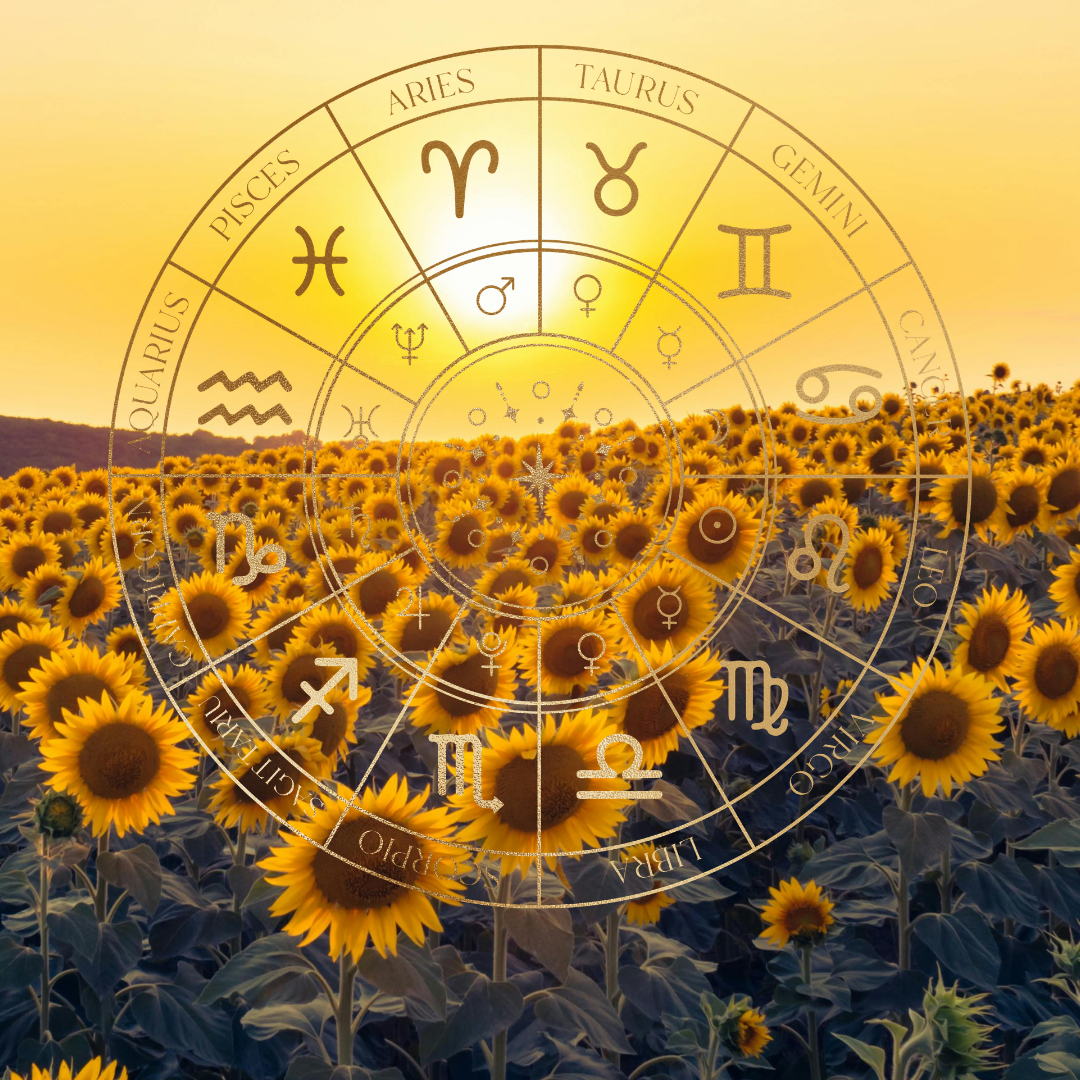
The Sun is more than a symbol of light!
In medical astrology and astrological herbalism, the Sun represents vitality, warmth, life force, the heart, spirit, radiance and our essential sense of self. It is the part of us that wants to shine, create, grow and express itself fully.
This makes Solar herbs particularly interesting when exploring states of depletion, weakness, melancholy, coldness, stagnation or diminished vitality. I find Solar herbs have such a broad application, and rarely are they not appropriate for most presentations in some form!
Astrological herbalism brings together two ancient traditions: herbal medicine and astrology. Rather than viewing a plant only through its chemical constituents or physical actions, we can also consider its traditional planetary correspondences, its shape, colour, habitat, historical uses and the parts of the body with which it has traditionally been associated. The Sun therefore gives us a particular lens through which to understand certain plants!
Solar herbs don’t necessarily need to be intensely stimulating. Some are bright and warming; others are gentle, restorative or protective. What they share is a correspondence with the qualities of the Sun: light, vitality, warmth, clarity, strength and restoration.
What does the Sun represent in medical astrology?
In traditional medical astrology, the Sun is associated with:
- Vitality and life force
- The heart and circulation
- Warmth and the generation of energy
- The eyes and vision (right eye for men, left eye for women to be more specific)
- The spirit and sense of self, ego
- Confidence and personal radiance
- Strength and resilience
- Recovery and regeneration
- Illumination, clarity and consciousness
The Sun is also traditionally associated with Leo, while the Sun is exalted (fares very well) in Aries.
From an astrological perspective, a Solar herb may therefore be one that is warming, uplifting, strengthening, brightening or restorative.. or one that has a particular traditional affinity with Solar organs such as the heart and eyes. But planetary rulership isn’t always about one obvious quality.vSometimes the correspondence is found in the plant itself – its golden flowers, upright growth or relationship with sunlight. Sometimes it comes from its traditional medicinal actions. Sometimes it is found in the organs it affects. This is why astrological herbalism brings a unique approach to understanding herbs.
Angelica – bringing light into darkness
Angelica archangelica
Warm, aromatic and stimulating, Angelica embodies the Sun’s ability to disperse cold, damp and stagnant states. Its tall, upright growth and name-meaning “angelic”- give it a luminous, protective quality.
Traditionally associated with vitality, digestion and circulation, its Solar symbolism can also be understood as bringing light into dark or transformative periods, helping us find strength and direction through times of change.
Chamomile – the gentle Sun
Matricaria chamomilla
With its bright, daisy-like flowers resembling miniature suns, Chamomile carries a gentle Solar signature. Traditionally used to soothe digestion, tension and irritability, it represents a softer expression of Solar energy: warmth and restoration without overwhelming the system.
Its nurturing, calming qualities also give it a secondary Lunar resonance, particularly in relation to the nervous system and “nervous belly.”
Celandine – illumination and transformation
Chelidonium majus
Celandine’s Solar correspondence is strongly linked to the eyes, traditionally ruled by the Sun, as well as its brilliant yellow-orange sap and flowers.
Its traditional affinity with the liver and gallbladder adds another Solar layer, connecting it with vitality, transformation and the body’s processes of clearing and renewal. Historically, Celandine has also been associated with the Sun in Leo.
Eyebright – seeing clearly
Euphrasia officinalis
Eyebright is strongly Solar through its traditional affinity with the eyes and vision. The Sun illuminates and reveals, making its traditional use for clarity of sight a particularly fitting correspondence.
It is also traditionally associated with the Sun in Virgo. Its use in seasonal allergies and upper respiratory complaints introduces a secondary Mercury/Virgo connection, linking the herb with the respiratory tract, immune responses and discernment.
St John’s Wort – bringing warmth back to the spirit
Hypericum perforatum
Few herbs carry such an obvious Solar signature as St John’s Wort. Its brilliant yellow flowers, relationship with sunlight and traditional use for melancholy, nervous exhaustion and wounds all reflect themes of light, warmth, vitality and restoration.
Symbolically, it can be understood as a Solar response to Saturnian qualities of heaviness and darkness, helping restore warmth and strength where vitality has become depleted.
Marigold – golden vitality
Calendula officinalis
Calendula’s brilliant golden-orange flowers immediately evoke the Sun. Traditionally associated with healing, protection, vitality and the heart, it carries a particularly strong Solar and Leo correspondence.
Its traditional use in wound healing and tissue support also reflects the Solar principle of restoring vitality and bringing damaged or depleted tissues back towards wholeness.
Rosemary – warmth and remembrance
Salvia rosmarinus
Warm, aromatic, evergreen and sun-loving, Rosemary is a classic Solar herb. It has traditionally been associated with the head, memory, circulation and heart, all areas with strong Solar correspondences. Also, associated with the zodiac sign of Aries (rules the head).
Its enduring evergreen nature also reflects the Sun’s symbolism of vitality, continuity and life force.
Saffron – golden vitality
Crocus sativus
My personal favourite. Saffron’s golden colour and traditional associations with the heart, mood, mind and vitality give it a strong Solar signature.
Associated traditionally with the Sun in Leo and the Sun’s exaltation in Aries, Saffron represents a bright, life-giving expression of Solar energy: warmth, vitality, courage and radiance.
Rhodiola – rebuilding the inner flame
Rhodiola rosea
Rhodiola expresses Solar energy through resilience, endurance and restored vitality, particularly in states of depletion. Its yellow flowers and ability to thrive in exposed, demanding environments reinforce its Solar symbolism.
Rather than simply representing stimulation, Rhodiola can be viewed as a herb of rebuilding the inner flame when reserves have been diminished.
My name is Ash, and I’m a naturopath and medical astrologer base in Kalamunda in the Perth Hills. If this interests you, book in for a naturopathic consult, or medical astrology chart reading!