
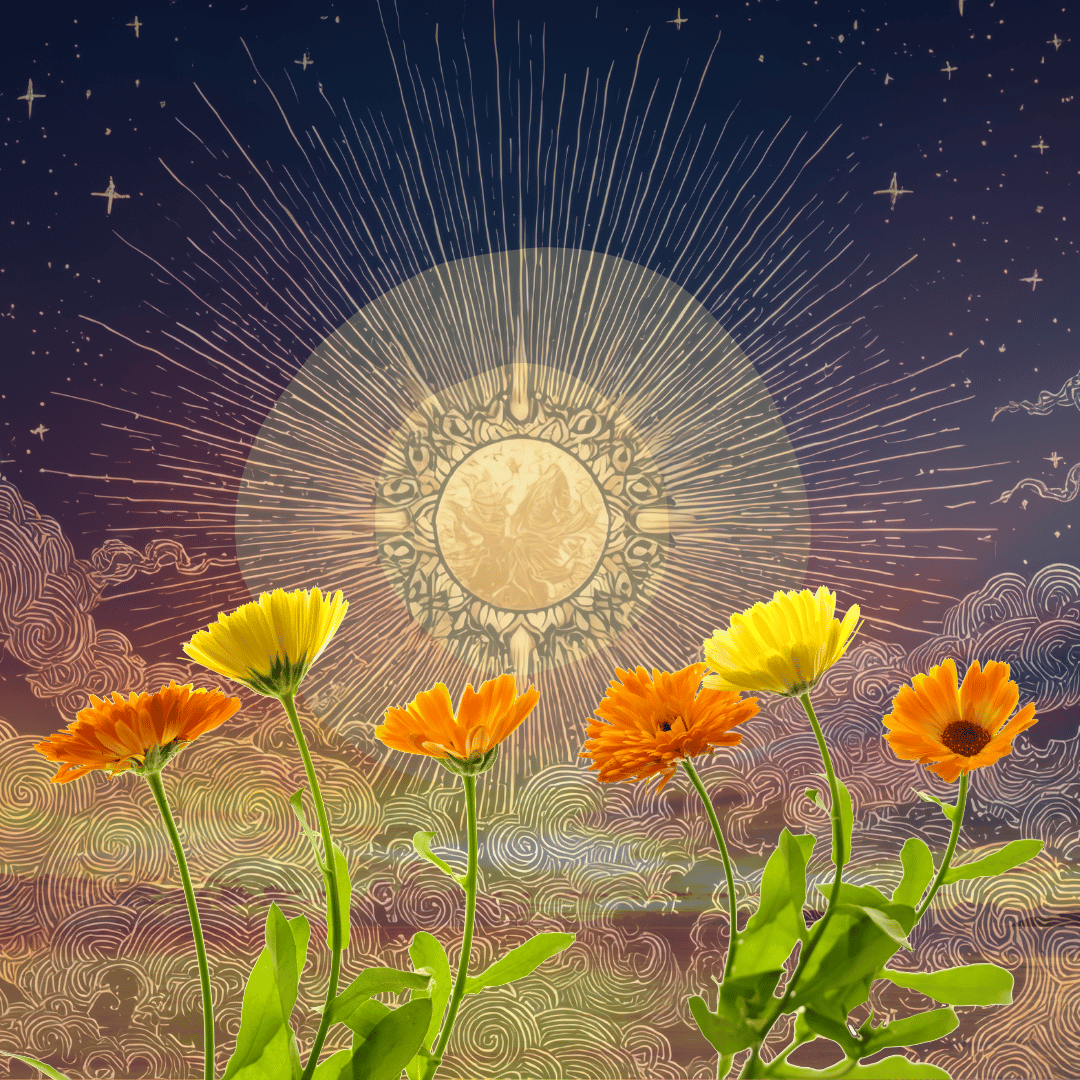
Of all the planetary families in astro-herbalism, the solar herbs may be the ones I find have the broadest application (and are my fav!)
Why? Because the Sun is at the centre of our solar system. It is the great giver of light, warmth and life. Without it there would be no life as we know it on Earth. The Sun represents our vital force, our inner fire, our capacity to thrive, and the unique essence we bring into the world.
In medical astrology, the Sun represents the animating principle of life itself. It is the spark that makes us more than a collection of biological processes. It speaks to our vitality, our spirit, our sense of purpose, and our ability to stand confidently in our own light. We all need solar energy. Not just the physical sunlight that sustains our biology, but the metaphorical Sun within us, the part that gives us courage, helps us find our direction, and allows us to express ourselves with confidence and authenticity.
When we are well connected to this solar principle, we have a certain radiance. We feel alive. We have the strength to meet life’s challenges, the courage to be seen, and the inner warmth to give generously without depleting ourselves. Remember, the Sun is not Mars. Its strength is not necessarily aggressive, combative or forceful. Mars is the warrior who charges into battle whereas the Sun is the sovereign who rules through presence, integrity and the steady radiance of their own authority.
The Sun does not need to fight for its light. It simply shines!
And so when I study (get to know) solar herbs, I look for these qualities: warmth, vitality, fortitude, illumination, courage, and the ability to strengthen and restore the life force.
Let’s explore some of these remarkable plants through the lens of astro-herbalism.
The Sun in Astro-Herbalism
Element: Fire
Temperament: Warm and dry, fortifying (not hot like Mars)
Traditional bodily correspondences: The heart, vitality, circulation, arteries, veins, blood, eyes, and the body’s fundamental life force. In some traditional systems, the Sun is also associated with the right eye in men and the left eye in women.
Energetic qualities: Warming, stimulating, tonifying, vitalising, fortifying, uplifting and nourishing.
Herbal correspondence examples: Calendula, Rosemary, Saffron, St John’s Wort, Hawthorn, Turmeric, Rhodiola, Guarana, and Celandine.
Solar herbs embody the Sun’s capacity to warm, invigorate, strengthen and illuminate. Some are stimulating, some nourish or support resilience, and others have a particular affinity with the heart or circulation.
In astro-herbalism, we look beyond a plant’s chemical constituents alone. We also consider its colour, shape, habitat, taste, medicinal actions, and the way it seems to express itself in the natural world.
A golden flower growing happily in full sunlight may suggest a solar correspondence. So might a warming aromatic herb that invigorates the senses, or a plant traditionally used to support vitality and lift the spirits. There’s a lot of nuance to this – and these are just simplified examples. These observations form part of an energetic and symbolic framework, complementing rather than replacing our understanding of pharmacology, clinical evidence and individual suitability.
Celandine. The Uncompromising Light of the Sun
Chelidonium majus
Celandine is an example of the more confronting expression of solar energy.
Its bright yellow flowers and striking yellow-orange sap immediately evoke the Sun. The sap is intensely coloured and bitter, carrying an unmistakable presence. In traditional herbalism, celandine was associated with the eyes, while its bitter constituents and traditional applications established a strong relationship with the liver and gallbladder. Its solar correspondence can therefore be understood through its colour, taste, traditional bodily affinities, and the symbolism of illumination and clearing. Celandine has also been associated with the Sun in Leo in herbal traditions (Leo is ruled by the Sun), reinforcing its connection to solar energy.
But what interests me most is the personality of this plant.
Celandine is not the gentle, comforting warmth of a summer afternoon. It is the person who walks into a room and immediately senses what is being left unsaid… and then says it. They see through superficiality, recognise where something has become stagnant, and have little patience for pretending that everything is fine when it clearly isn’t.
Their bitterness is not necessarily cynicism. It is uncompromising realism. They do not sugarcoat uncomfortable truths or offer empty reassurance simply to keep the peace. They are willing to name the elephant in the room, even when everyone else would prefer to look away. It’s pretty bolshy – and this makes sense as it is a herb you need a herbalist to prescribe due to it’s potency and potential for toxicity.
There is a cleansing quality to this archetype. Just as the Sun illuminates what was hidden in darkness, this plant personality brings things into the open. They challenge denial, expose contradictions, and insist on authenticity. At their best, they help us face reality so that genuine change can begin.
But every planetary archetype has its shadow.
When solar energy becomes excessive, confidence can become arrogance, leadership can become domination, and conviction can become an unwillingness to consider another perspective. The person may become overbearing, self-important or convinced that their truth is the only truth. This is the shadow of the sovereign who has forgotten that authority is a responsibility, not a licence to control. This is an archetypal example of the personality that would benefit from Celandine (of course prescribed along side proper consultation).
Celandine represents the more severe expression of the Sun in Leo: a powerful, uncompromising light that can reveal what needs to change, but which must be tempered with humility and discernment.
An important distinction: this is an astro-herbalism symbolic interpretation, not a personality diagnosis or an indication to prescribe the plant. Celandine can cause serious liver injury and is not an appropriate herb for casual self-treatment!
Saffron. The Quiet Power of Spiritual Royalty
Crocus sativus
Saffron is one of the most exquisite examples of solar medicine. It’s one of my most beloved, and favourite herbs!
The golden-orange stigmas, harvested from the delicate purple crocus flower, are among the most precious spices in the world. Even in appearance, saffron seems to carry an air of refinement. Its colour evokes sunlight, gold, abundance and the radiance of life itself.
In traditional herbalism, saffron has been associated with the heart, vitality and the uplifting of the spirits. Modern research has also investigated its potential effects on mood.
From an astro-herbalism perspective, saffron embodies a particularly elevated expression of the Sun. The Sun in Leo is associated with royalty, dignity and the sovereign self. Saffron seems to express this through its rarity, its preciousness, and the extraordinary concentration of its most valued part into a few delicate threads.
I think of this as spiritual royalty.
Not royalty in the sense of superiority, status or wealth accumulated at the expense of others. Rather, it is the quiet recognition of one’s own inherent worth. The capacity to inhabit your life with dignity, to honour your gifts, and to recognise that your presence has value simply because you are here.
There is something especially beautiful about the flower itself. Purple petals surround the vivid red-orange stigmas, which rise from within the bloom. The purple colour has traditionally been associated with the crown chakra and higher spiritual awareness. The elevated position of the stigmas also lends itself to a symbolic reading of saffron as a plant of refinement, subtlety and spiritual aspiration.
Where a root medicine may symbolically draw us down into the earth, grounding us in the body and the material world, saffron seems to lift the imagination upwards. Its energetic personality is delicate rather than heavy, luminous rather than forceful, and precious without needing to be loud.
The stigmas themselves hold a concentrated intensity. They are small, but powerful in colour and character. To me, this is a beautiful image of quiet strength, the kind that does not need to dominate a room to change its atmosphere.
Saffron also blooms in autumn, when the natural world begins its descent towards winter. Symbolically, this is especially meaningful. The Sun does not disappear simply because the days grow darker. Its light remains a source of orientation, even when we cannot feel its warmth as readily. In this sense, saffron represents the possibility of retaining an inner light through difficult seasons. It invites us to remember our dignity, our spiritual connection and our capacity for beauty, even when life feels heavy.
Its mood-related properties have made saffron a subject of scientific investigation, but its symbolic role in astro-herbalism reaches beyond a single therapeutic action. It speaks to the restoration of lightness, the cultivation of self-worth, and the quiet radiance that comes from being connected to one’s spiritual nature.
Working With Solar Herbs
Solar herbs are not simply herbs for people born under Leo, nor are they exclusively remedies for those who feel tired or depleted. In astro-herbalism, planetary correspondences offer another way to understand the nature of a plant and the qualities it may symbolically bring to a formulation. We might consider solar herbs when exploring themes of vitality, warmth, courage, resilience, clarity and the heart.
But context matters!
The Sun’s warmth can be restorative where there is coldness and stagnation – yet excessive heat or stimulation may be unhelpful for someone who is already overstimulated, inflamed or depleted by prolonged stress. A stimulating herb is not automatically appropriate for every person experiencing fatigue, just as a traditionally solar plant is not automatically the right choice for someone with a prominent Sun in their birth chart. We absolutely must still consider the person’s constitution, symptoms, medical history, medications, contraindications and the plant’s pharmacology.
This is where I find astro-herbalism particularly enriching. It does not need to compete with modern herbal medicine. Instead, it gives us another language through which to contemplate the plants we work with.
A Final Thought
The Sun reminds us that health is not merely the absence of symptoms. It is also the capacity to live with vitality, to express ourselves authentically, and to participate in life with a sense of purpose.
In astro-herbalism, I see solar plants as reminders of these qualities. They invite us to consider where our light is flourishing, where it has dimmed, and where we might need to restore our strength without burning ourselves out. Perhaps the deeper question is not simply which solar herb might support us, but how we are tending to our own inner Sun. Are we giving ourselves the nourishment and rest we need to thrive? Are we living in a way that honours our values? Do we have the courage to be seen as we truly are, rather than shrinking ourselves to fit the expectations of others?
The Sun does not ask permission to shine. It simply fulfils its nature. Perhaps part of our own healing journey is learning to do the same.
I’m Ashleigh, a naturopath and medical astrologer based in Kalamunda in Perth’s Hills. At BioSoul, I bring together traditional herbal wisdom, modern naturopathic practice and the symbolic language of medical astrology to explore health from multiple perspectives.
If you’re curious about medical astrology, herbal energetics or a more holistic understanding of your health, you’re welcome to explore my other articles or enquire about a consultation for yourself!